The AI Model Race Is Heating Up — and That's Good News for Everyone
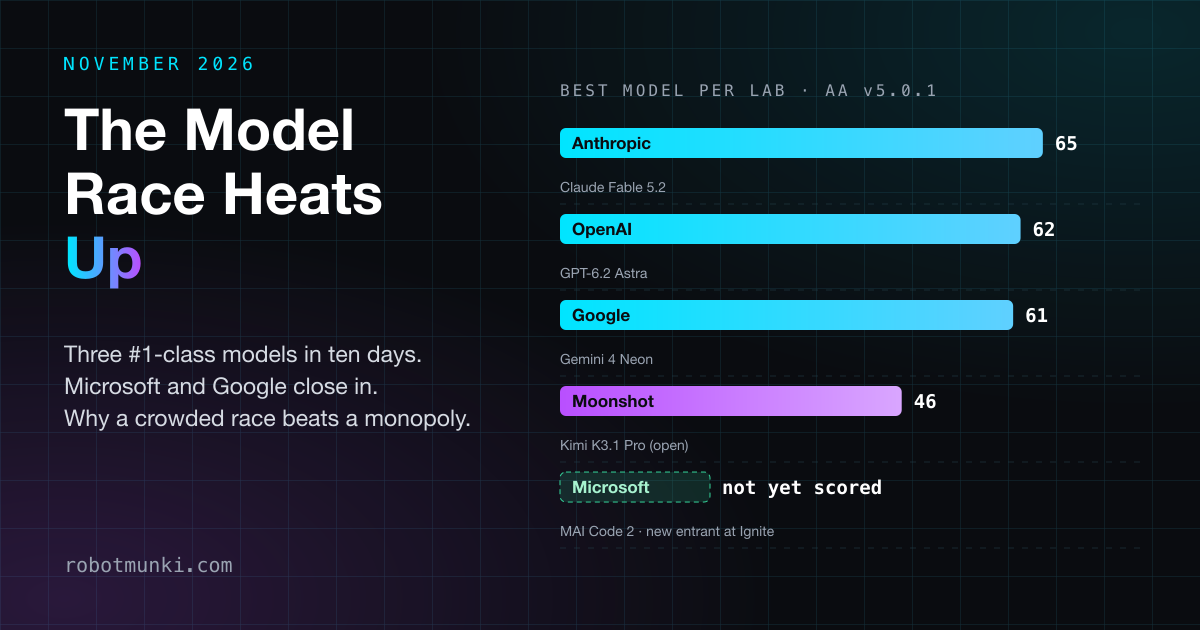
On November 3 the best score on the Artificial Analysis Intelligence Index was 59. Sixteen days later, three different labs have beaten it. Anthropic shipped Claude Fable 5.2 (65) on November 9, OpenAI answered with GPT-6.2 Astra (62) on November 17, and Google followed with Gemini 4 Neon (61) the next day. In the same week, Microsoft used Ignite to launch seven in-house MAI models aimed squarely at the workloads it used to hand to partners. You could read this as hype-cycle noise. I read it as the best thing that could happen to people who actually buy and build on these models: nobody gets to be the only option.
For the full rankings and per-use-case picks, see the updated LLM Landscape leaderboard and the model selector. Benchmark numbers below are independent Artificial Analysis (AA) results unless marked as vendor-reported.Ten days in November
| Date | Lab | Release | AA Index v5.0.1 | Price ($/M in / out) | Why it matters |
|---|---|---|---|---|---|
| Nov 9 | Anthropic | Claude Fable 5.2 | 65 | $8 / $40 | New #1 by three points, and cheaper than Fable 5.1 ($10 / $50) |
| Nov 12 | Gemini 4 Hydrogen | 54 | $1.50 / $7.50 | A fast tier that scores within a few points of last month's leaders | |
| Nov 17 | OpenAI | GPT-6.2 Astra | 62 | $8 / $40 | #2 overall, priced 20% below GPT-6 Astra |
| Nov 17 | OpenAI | GPT-6.2 Sol | 57 | $2 / $10 | Two points better than 6.1 Sol at the same price |
| Nov 17 | Microsoft | MAI Code 2, Code 2 Flash + five more | not yet scored | Code 2: price TBA | A hyperscaler's own coding models, in GitHub Copilot on day one |
| Nov 18 | Gemini 4 Neon | 61 | $3 / $15 | #1 on AA's Coding Agent Index at about half the cost per task of Opus 5.5 |
Why a crowded race is good for you
1. Prices fall when nobody can sit still
Every release in that table either cut a price or held one while capability rose. Fable 5.2 is cheaper than the Fable it replaced. GPT-6.2 Astra is 20% cheaper than GPT-6 Astra, and its cached input dropped from $1.00 to $0.40. GPT-6.2 Sol gained two points at an unchanged $2 / $10. Gemini 4 Neon's cached input is $0.15, a 95% discount. At the low end, Muse Ember and Claude Haiku 5.5 both score 36 at $0.10 / $0.50.The more important number is cost per task. On the same index, GPT-6.2 Astra costs about $4 per task at max effort and Fable 5.2 about $26.54, even though both list at $8 / $40. Neon at xhigh comes in around $6.44. When three labs are within four points of each other, efficiency becomes the thing they compete on, and that savings goes to buyers.2. No single gatekeeper
A one-vendor market would let that vendor decide who gets access, on what terms, and with which safety and usage policies. That risk isn't theoretical. This autumn Google launched Gemini 4 Carbon to vetted cyber defenders only, and GPT-6 Astra was reportedly access-gated on similar grounds. When one lab restricts a model today, you can switch to another lab's comparable one. With four Western labs, Moonshot, Alibaba, DeepSeek, and a growing set of Apache-licensed open models, no single company controls access to frontier-class intelligence. That matters for startups, for regulated industries, and for countries that don't want their AI strategy to depend on one company's roadmap.3. Specialization means you pick the right tool
When a dozen labs are chasing the same leaderboard, the smart ones differentiate. Google built Neon for long-running, tool-heavy agents. Microsoft built separate models for coding, cyber defense, speech, transcription, images, and routing instead of one model for everything. Decision models, diffusion LLMs, and sovereign EU models all exist because there was room to compete on something other than the headline score. Buyers end up with a toolbox rather than a single hammer.4. Leverage and resilience
If your product runs on one provider, that provider's outages, price changes, and deprecations are your problem. With three near-equivalent frontier options and strong mid-tier alternatives, you can route around failures, negotiate on price, and move workloads when a model regresses. AA noted, for example, that GPT-6.2 Sol dipped three points on its Coding Agent Index even as its overall score rose. In a competitive market, that gives you a reason to pick a different model for coding, not a reason to accept a regression.5. Open weights keep everyone honest
Closed labs can't price too far above what you could run yourself. Kimi K3.1 Pro at 46 is now about 19 points behind the leader, down from 26 two weeks ago. Inkling 2 Small gives US and EU teams a credible Apache 2.0 option. Every capable open release puts a ceiling on what closed APIs can charge for mid-tier work.Google: from "skipped a generation" to setting the price-performance bar
Two months ago Google looked like it was behind. It cancelled Gemini 3.5 Pro on September 30 and bet on a clean break to Gemini 4. Its strongest model, Gemini 4 Carbon, launched restricted to vetted cyber defenders. The November releases show what that reset was for.- A full family, not a single flagship. Hydrogen (fast, $1.50 / $7.50, 54) handles everyday execution, Neon ($3 / $15, 61) balances depth and efficiency, Carbon (60) targets the hardest long-horizon projects, and Argon keeps its 1M-token output limit. Google now has four models in AA's top 10.
- Neon beats its own big brother. At xhigh, Neon out-scores Carbon on the AA index while costing less per task. Google says Neon at its default setting costs 32% less per task than Carbon and 50–80% less than top competing frontier models.
- Leading where the money is: coding agents. On AA's Coding Agent Index, Neon in Google's Antigravity harness scores 59 at about $6.86 per task, against 58 for both Claude Opus 5.5 ($12.61) and Fable 5.2 ($15.47). Google also reports 65.2% on Terminal-Bench 4.1 and 46.2% on FrontierCode 2.0 (vendor-reported).
- Agents as a product pattern. In Antigravity, Neon acts as an orchestrator that directs parallel Hydrogen subagents. The workflow is designed around a mix of models, not one.
- Safety as a selling point. Google reports a 0.09% misaligned-action rate on its agentic safety suite, 99.2% on agent honesty, and 0.0% attack success on the Gray Swan prompt-injection benchmark at the highest thinking level (vendor-reported).
Microsoft: building its own bench
For most of the generative-AI era, Microsoft's Copilot products ran mainly on its partner OpenAI's models. At Ignite 2026, Microsoft AI positioned itself as a model lab in its own right, under the theme "your IQ, your agents, your weights." It released seven models at once:| Model | What it's for | Headline claim (vendor-reported) | Availability |
|---|---|---|---|
| MAI Code 2 | Everyday enterprise coding | 98% of GPT-6.1 Sol's score at 40% of the cost; 96% of Claude Opus 5.5's at 5% of the cost (avg. of DeepSWE 1.1, Terminal Bench 2.1, SWE-Atlas, FrontierCode v1.1); preferred over GPT-6 Sol 64% of the time in blind frontend tests | GitHub Copilot now; OpenRouter, Vercel, and others "soon" |
| MAI Code 2 Flash | High-volume routine coding | Comparable to GPT-6 Luna at 65% of the price and Claude Haiku 5.5 at 20% | GitHub Copilot; limited Foundry preview |
| MAI Cyber 2 Flash | 24/7 agentic cyber defense | 92.3% on CyberGym-E2E vs GPT-6 Astra's 91.5%, at under 2% of the cost; $0.10 / $0.50 list; 1M context | Microsoft security products from mid-December |
| MAI Image 2.7 | Image generation and editing | #1 on AA's image-editing leaderboard; #4 text-to-image; Flash at ~$10 per 1,000 images | Microsoft Foundry |
| MAI Realtime 1 | Live speech-to-speech | Beats GPT-Realtime 2.1 on quality, speed, and price; from $0.01 per audio minute | MAI Labs; Foundry limited preview |
| MAI Transcribe 2 (in Dragon Copilot) | Clinical transcription | Halved multilingual error rates; 10 million encounters a month | Dragon Copilot |
| Decision 1.1 | Routing to the right-sized model | 50× faster and 79× cheaper than GPT-6.1 Sol; ~4,000 customers | Generally available |
The caveats of a hot race
Competition isn't automatically good. The same speed that lowers prices also creates real costs:- Benchmark churn. AA has gone through v4.1, v4.2, v4.3, v5.0, and v5.0.1 since August. Scores move a point just from methodology changes. Don't switch providers over a one-point gap.
- Vendor-reported numbers multiply. Google's and Microsoft's posts are full of "#1" claims on benchmarks many readers have never heard of. Look for independent replication before you treat one as settled.
- Version fatigue. GPT-6 Astra, GPT-6.1 Sol, and Claude Fable 5.1 were all current a month ago. Expect more frequent deprecations and plan for them.
- Safety under pressure. A race can reward shipping fast over shipping carefully. It's encouraging that Google led with agentic-safety metrics and Microsoft called security and containment its top priority for 2027, but keep watching what labs publish, not just what they claim.
What to do about it
- Abstract the provider. Put a thin routing layer between your app and the model APIs (many gateways now speak both OpenAI and Anthropic formats). Switching should be a config change, not a rewrite.
- Keep a private eval set. Ten to fifty real tasks from your own product, scored automatically. Rerun it whenever a new model ships; this month that would have been four times.
- Measure cost per solved task, not price per token. Two models with the same list price differed by more than 6× in cost per task this month.
- Route by difficulty. Send the hard planning step to a frontier model, everyday work to a Neon/Sol/Code 2-class model, and classification and routing to a Hydrogen/Haiku/Ember-tier model or a decision model.
- Keep an open-weight fallback. Kimi K3.1 Pro, DeepSeek V4.1 Flash, and Inkling 2 Small make a credible self-hosted plan B if pricing or access changes.
The bottom line
A year ago it was reasonable to worry that frontier AI would consolidate around one or two companies. November 2026 suggests otherwise. Anthropic holds the top score, OpenAI holds the best value, Google holds the coding-agent crown and the best price-performance, Microsoft is building a full in-house stack, and open weights are closing the gap again. Every one of them has to keep shipping, keep cutting prices, and keep earning your traffic. For anyone building on AI, that competition is a good thing.Sources: Google, “Introducing Gemini 4 Neon” (Nov 18, 2026) and the Gemini 4 Neon model card; Microsoft AI, “Seven new world-class models at scalable price-performance” (Ignite, Nov 17, 2026) and the MAI Code 2, MAI Cyber 2 Flash, MAI Realtime 1, and MAI Licensed Weights announcements; Artificial Analysis leaderboards, model pages, Coding Agent Index, and articles on Gemini 4 Neon and GPT-6.2 (fetched Nov 19, 2026; Intelligence Index v5.0.1). Vendor-reported figures are labeled as such.